Snapchat Planets in Order:Meanings & Friend Solar System Guide (2026)
If you use Snapchat, you may have seen a small planet badge next to a friend’s profile and wondered what it means.
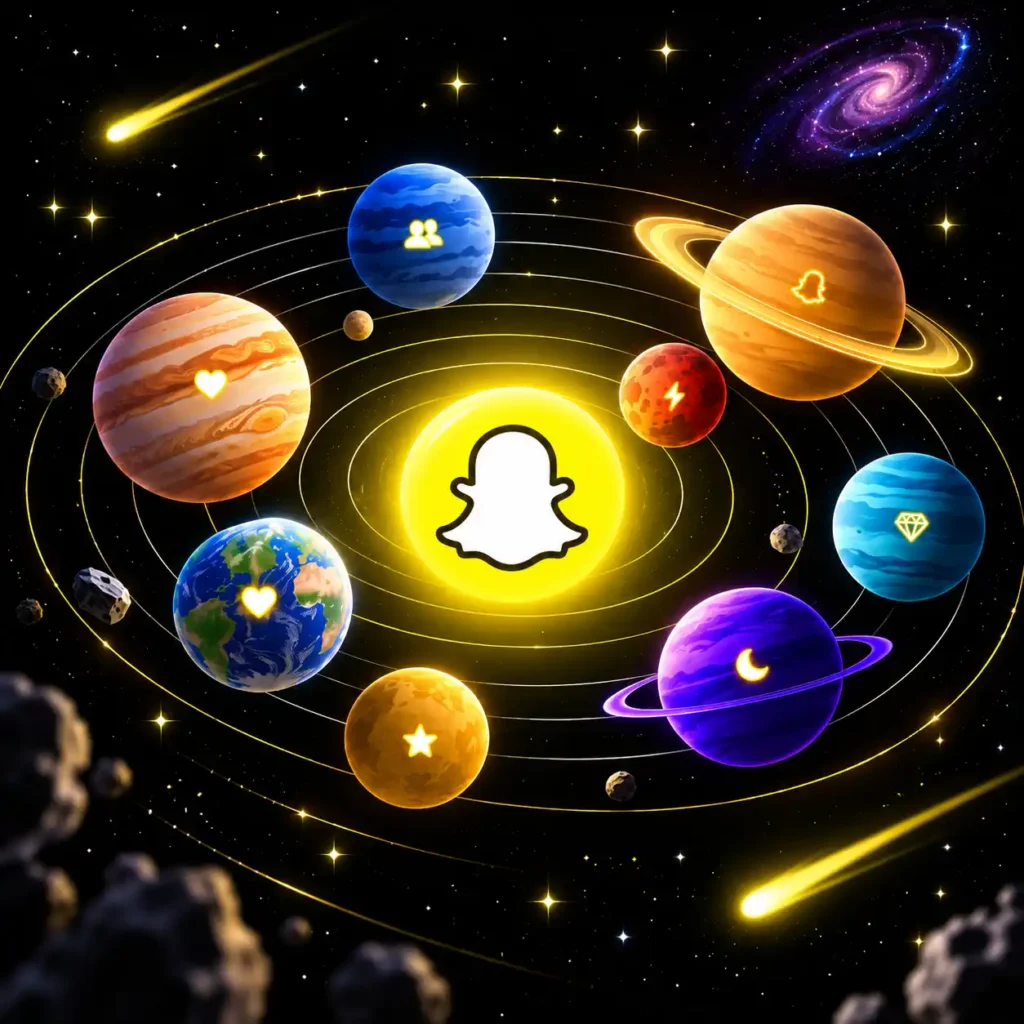
That badge represents Snapchat Planets (officially called the Friend Solar System) an exclusive feature for Snapchat+ subscribers that visualizes where you stand on a friend’s Best Friends list. In this setup, your friend represents the Sun, and their top eight closest friends orbit them as planets, ordered by closeness from Mercury (#1) out to Neptune (#8).
Here is everything you need to know about snap planets, what each planet looks like, how the order works, and how to find your place in your friend’s orbit.
What Are Snapchat Planets?
Snapchat planets are a visual ranking system for close friends. Instead of showing a plain numbered list of who you talk to most, Snapchat turns your friendship circle into a mini solar system.
How the Snapchat Solar System Works
In your friend's solar system, they are the center of the universe, represented as a smiling Sun. Their top eight closest friends are assigned one of the eight planets in our real solar system: Mercury, Venus, Earth, Mars, Jupiter, Saturn, Uranus, and Neptune. Where you land depends on how often you and your friend send Snaps and chats to each other. If you are their number one best friend, you will show up as Mercury, the planet closest to the Sun. If you are their eighth best friend, you will appear as Neptune, the farthest planet.
Do You Need Snapchat+ to See Your Planet?
Yes. The Friend Solar System is an exclusive feature for Snapchat+ subscribers. In the United States, a subscription costs $3.99 per month (or $29.99 per year). If you use the free version of Snapchat, you cannot see your planet ranking on anyone’s profile. However, you can still be a planet in a subscriber’s solar system without paying. You just will not be able to look up your position yourself.
Snapchat Planets in Order: Quick Reference Chart & Meanings
If you just need a quick answer to figure out which planet you saw on a profile, use this simple reference chart. It lists every snap planet in order from closest to farthest, along with its rank and visual design.
| Order | Planet | Friend Rank | Visual Description | Meaning |
|---|---|---|---|---|
| 1st | Mercury | #1 Best Friend | Red planet with 5 red hearts | You talk and Snap with this person more than anyone else. |
| 2nd | Venus | #2 Best Friend | Light brown planet with pink, yellow, and blue hearts | You are their second closest friend on the app. |
| 3rd | Earth | #3 Best Friend | Blue and green globe with red hearts, stars, and the Moon | You are their third closest friend with daily contact. |
| 4th | Mars | #4 Best Friend | Red planet with stars and purple and blue hearts | You are their fourth closest friend. |
| 5th | Jupiter | #5 Best Friend | Orange planet with dark stripes and stars (no hearts) | You are in their top five, but outside the inner circle. |
| 6th | Saturn | #6 Best Friend | Yellow-orange planet with a ring and stars (no hearts) | You share regular Snaps, but chat less frequently. |
| 7th | Uranus | #7 Best Friend | Plain green planet with stars (no hearts) | You are an occasional best friend. |
| 8th | Neptune | #8 Best Friend | Dark blue planet with stars (no hearts) | You are holding the final spot on their Best Friends list. |
Notice the pattern with the hearts: only the four inner planets have floating hearts around them. Once you reach Jupiter and the outer gas giants, the hearts disappear, leaving only stars and rings.
1. Mercury – #1 Best Friend (Inner Circle)
Mercury is the closest planet to the Sun, which means you are this person’s number one best friend on Snapchat.
On the screen, Mercury appears as a fiery red circular planet surrounded by five bright red hearts. If you see Mercury on someone’s profile, you share more Snaps and direct messages with them than anyone else on their contact list.
2. Venus – #2 Best Friend
Venus sits second from the Sun and represents your friend’s second closest contact.
Snapchat designs Venus as a warm, light brown or tan planet. Unlike Mercury, Venus has colorful hearts floating around it, including soft shades of pink, yellow, and baby blue.
3. Earth – #3 Best Friend
Earth is the third planet from the Sun, matching the position of your third best friend.
The app shows Earth as a familiar blue and green globe. It features glowing stars, classic red hearts, and a tiny gray Moon orbiting beside it. The presence of the Moon makes Earth one of the easiest planets to identify at a glance.
4. Mars – #4 Best Friend
Mars is the fourth planet from the Sun, marking your spot as the fourth closest friend.
Snapchat depicts Mars as a reddish planet, but you can tell it apart from Mercury by looking at the floating symbols. While Mercury only has red hearts, Mars is surrounded by sparkling stars and a mix of purple and deep blue hearts. This is also the last planet in the lineup to feature any hearts at all.
5. Jupiter – #5 Best Friend (Outer Gas Giants)
Jupiter represents the fifth best friend. In real astronomy, Jupiter marks the beginning of the outer gas giants, and Snapchat reflects this in its artwork.
Jupiter appears as a large, reddish-orange planet covered in dark horizontal stripes, surrounded by tiny yellow stars. Starting with Jupiter, there are no floating hearts. That visual change is a clear sign that you are moving past the core inner circle into broader friendship territory.
6. Saturn – #6 Best Friend
Saturn is the sixth planet in the solar system, representing the sixth closest person on a friend's list.
Snapchat makes Saturn easy to spot by giving it a distinct golden-brown planetary ring and a halo of small stars. If you see Saturn, you and your friend likely trade daily Snaps to keep a streak alive, but you probably do not send long direct messages back and forth every day.
7. Uranus – #7 Best Friend
Uranus holds the seventh position on the Best Friends list.
It is drawn as a smooth, green-colored planet with faint stars floating around it. There are no rings, no moons, and no hearts. Landing on Uranus usually means you and your friend interact every few days, but not enough to compete with their top five contacts.
8. Neptune – #8 Best Friend
Neptune is the eighth and final planet in the Snapchat solar system.
It appears as a dark, desolate blue sphere floating alone in a field of stars. While being on Neptune means you barely made it onto their top eight Best Friends list, you are still in their top tier compared to everyone else on their friends list.
Mnemonic Trick: How to Remember the Snapchat Planet Order
If you are trying to remember the order of snap planets without opening a guide every time, you can use the classic grade-school sentence:
- My = Mercury (#1)
- Very = Venus (#2)
- Energetic = Earth (#3)
- Mom = Mars (#4)
- Just = Jupiter (#5)
- Served = Saturn (#6)
- Us = Uranus (#7)
- Nachos = Neptune (#8)
The first letter of each word matches the planet in order from closest to farthest.
What Do the Snapchat Badges Mean?
When you open a friend’s profile page, you might see a small badge sitting right below their Bitmoji. That badge tells you about the balance of your friendship.
Gold Best Friends Badge (Mutual Top 8)
If you see a badge that says Best Friends with a shiny gold ring around it, you and that person share a mutual connection. You are in their top eight best friends, and they are also in your top eight. Tapping on this gold badge opens the solar system view and shows you your exact planet.
Purple Friends Badge (One-Sided Orbit)
If the badge simply says Friends with a dark or purple outline, the relationship is one-sided on the app. It means you are in their top eight best friends, but they do not interact with you enough to make it into your personal top eight. You can still tap this badge to see where you sit in their solar system.
What It Means When There Is No Badge
If there is no badge under your friend’s name at all, one of three things is happening:
- 01 Neither of you is in the other person's top eight best friends.
- 02 You do not have an active Snapchat+ subscription.
- 03 One of you has turned the Solar System feature off in settings.
How to Enable and Check Your Snapchat Planet
Before you try looking up your planet, keep in mind that the feature might be turned off on your account.
How to Turn On the Friend Solar System (Post-2024 Opt-In)
When Snapchat first launched the solar system feature, it was turned on automatically for all paid users. However, in April 2024, Snap updated its policy following a widely discussed Wall Street Journal report on how friend rankings were causing anxiety among teenagers.
To help protect user well-being, Snap announced on its official newsroom that the Friend Solar System would be turned off by default.
If you are a new or recent subscriber, you must turn it on manually:
- Open Snapchat and tap your profile icon in the top left corner.
- Tap your black Snapchat+ membership banner.
- Scroll through the list of features until you find Solar System.
- Switch the toggle to On.
You can switch this toggle off at any point if you ever want to hide the feature again.
How to Find Your Planet on a Friend’s Profile
Once the feature is switched on, checking your standing takes only two taps:
- Open your chat feed and tap on your friend's Bitmoji avatar to open their Friendship Profile.
- Look directly below their name for the Best Friends or Friends badge.
- Tap the badge. A graphic will pop up showing your friend as the Sun and your personal Bitmoji riding on your assigned planet.
How Does the Snapchat Planet Ranking Algorithm Work?
Snapchat does not let you pick your favorite planet or manually assign friends to specific spots. Everything is handled by a private computer formula that measures how you interact on the app.
Interactions That Boost Your Planet Standing
To move closer to the Sun and climb toward Mercury, focus on direct, two-way actions:
- 01 Direct Snaps: Sending photo and video Snaps back and forth is the single most important factor. Snaps sent directly to one person carry far more weight than plain text messages.
- 02 Consistent 1-on-1 Chatting: Having regular conversations throughout the week helps solidify your spot.
- 03 Snapstreaks: Keeping a long, unbroken Snapstreak shows steady communication, which prevents your ranking from dropping overnight.
- 04 Story Replies: Replying to a friend's private or public story and starting a chat adds extra activity points.
Why Your Snapchat Planet Changes (And What Does NOT Count)
Snapchat calculates rankings over a rolling window of several weeks. If you stop talking to a friend for four or five days, someone else who is actively snapping them can take your spot. That is why you might wake up and find that you slipped from Venus down to Jupiter.
It also helps to know what the algorithm ignores:
- 01 Group Chats Do Not Count: Sending Snaps or messages inside a group chat has zero effect on your individual Best Friends ranking. Only direct 1-on-1 messages count.
- 02 Story Views Do Not Count: Watching someone's stories without replying will not move you an inch closer to their Sun.
- 03 Profile Checks Do Not Count: Opening someone’s profile or checking their location on the Snap Map does not boost your score.
Why Are Snapchat Planets Not Showing? (Troubleshooting)
If you are trying to view a solar system but cannot find the planet badge, run through these common fixes:
Missing Subscription or Expired Plan
Double-check that your Snapchat+ subscription is active. If your monthly billing failed or your plan ran out, the badges will vanish instantly. Free accounts cannot view planet badges under any circumstances.
Solar System Feature Toggled Off
Because the feature is disabled by default for new members, check your Snapchat+ settings screen. If the toggle next to Solar System is gray, turn it green to activate the badges.
Bitmoji and App Cache Issues
For the solar system animation to render properly, both you and your friend must have an active 3D Bitmoji linked to your accounts. If either person deletes their Bitmoji, the planet screen cannot display.
If both accounts have Bitmojis and the badge still fails to load, try clearing the app’s temporary data. Go to Settings, scroll down to Account Actions, tap Clear Cache, and restart the app.
Privacy: Can Other People See Your Snapchat Solar System?
A common worry among users is that other people might be able to see their entire friend hierarchy.
Fortunately, the system has strict privacy limits. Nobody can view your full solar system.
When your friend taps the badge on your profile, they can only see where they stand in relation to you. They have no way of knowing who your other seven planets are, who is holding Mercury, or who is sitting on Neptune. Your complete list of best friends remains private to you.
Snapchat Planets vs. Classic Best Friends Emojis
Long-time Snapchat users often wonder how planets compare to the classic friend emojis that appear directly on the main chat screen.
Both systems use the same activity data, but they show it in different ways:
- Chat Screen Emojis: Available to everyone for free. A gold heart indicates you are each other's #1 best friend for two weeks, while pink hearts mean you have held that top spot for two straight months.
- Snapchat Planets: Available only to Snapchat+ members. Instead of tracking time milestones, planets show your exact numeric placement from position 1 to 8 in an interactive graphic.
In short, emojis celebrate how long you have stayed best friends, while planets show exactly where you rank today.
Frequently Asked Questions
Can you see Snapchat planets without paying for Snapchat+?
No. While anyone can unknowingly be a planet in someone else’s orbit, only paying Snapchat+ subscribers can open a profile and view the solar system graphic.
Can you choose who is your Mercury on Snapchat?
No. The planet order is determined entirely by how much you talk and Snap with each person. However, Snapchat+ does offer a separate feature called “Pin as #1 BFF,” which keeps your favorite person pinned to the very top of your chat feed regardless of your planet standing.
Why did my planet suddenly drop from Earth to Saturn?
Because planet rankings use a rolling schedule, your rank can drop if you and your friend slow down your daily Snaps, or if your friend begins snapping someone else much more frequently.
Does someone know if you check their Snapchat planet?
No. Opening a friend’s profile and tapping their badge is private. Snapchat does not send a notification or alert when you look at their solar system.
How many best friends can you have in a Snapchat solar system?
The Friend Solar System only includes eight planets, representing the top eight closest contacts. Even though Snapchat+ allows users to expand their text-based Best Friends list up to 16 people, the planetary graphic stops at Neptune.